The Challenge
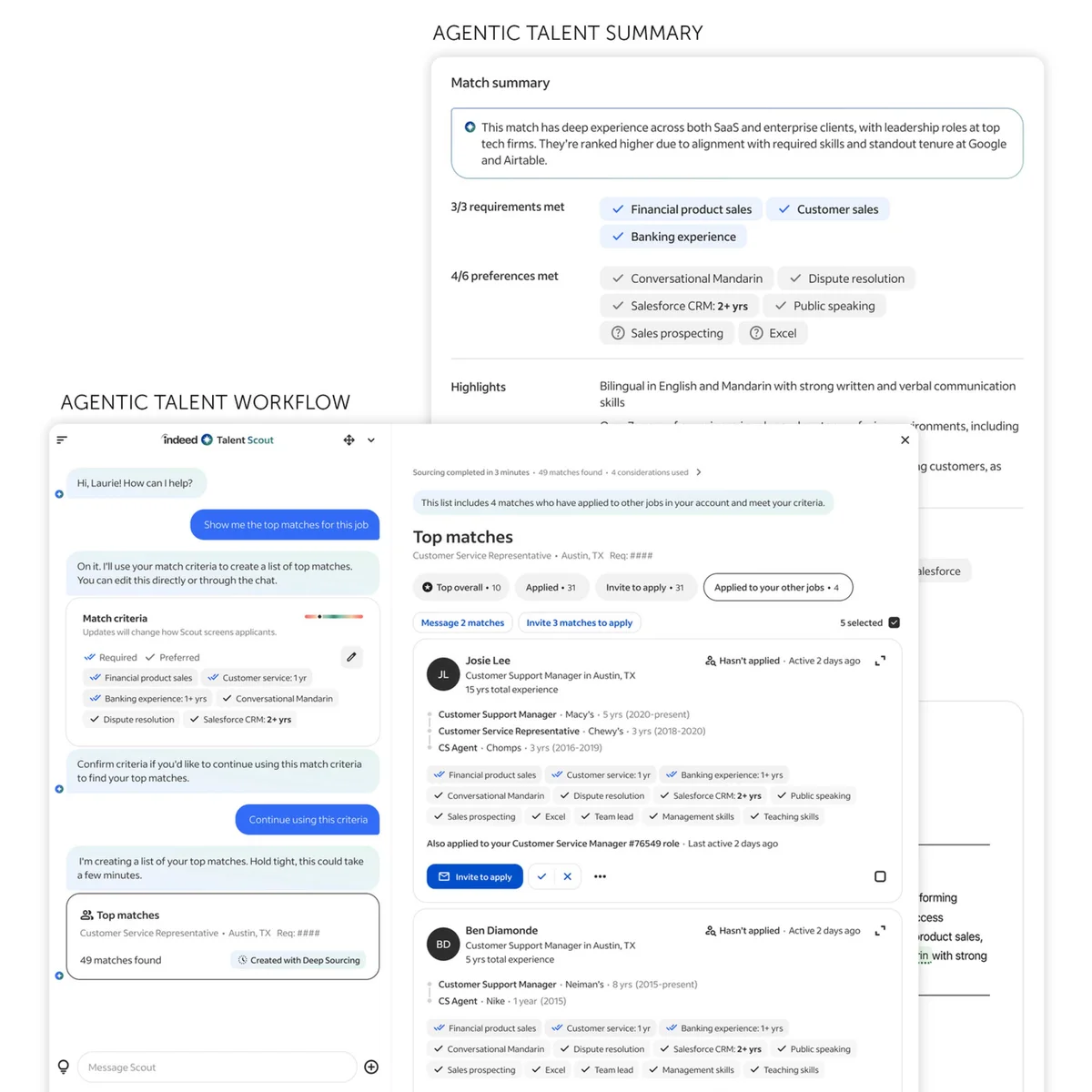
Candidate search was passive and fragmented. Pre-apply sourcing and post-apply hiring lived in separate systems, each with its own queries, results, and workflows. This made it difficult to identify the best candidates across products or maintain a clear view of the hiring journey.
The opportunity was to create a system that could plan and execute multi-strategy searches across products, surface results with clear context, and guide employers toward meaningful next actions throughout the hiring process. The risk was significant. Without high-quality results and a process employers could trust, the system would not be adopted.
Approach
Build, observe, adapt
Rather than defining the experience upfront and validating later, we moved to a real product early. Design and engineering worked together in code throughout the process, allowing ideas to be tested immediately in real scenarios with real backends.
The key deciding factor was not ideal mocked results. It was real search results. We needed to understand what actually worked before the product moved forward and scaled.
Research and product development ran in parallel, so decisions were shaped by real candidates and employer behavior, not assumptions.
Defining the AI Sourcing System
Early concepts were not just about interface, but about how the system should behave.
The core question was how AI could search for candidates in a way that outperformed traditional query-based methods. Instead of relying on a single query, the system needed to interpret hiring criteria, generate multiple search strategies, rank and merge results across those strategies, evaluate the quality of those results, and continuously iterate until meaningful candidates were found.
Rather than defining this behavior in theory, it was brought into a real product early.
What this revealed was critical. A single search approach was not sufficient for complex hiring needs, and employers needed visibility into how results were generated. Ranking across multiple strategies proved essential to surfacing quality candidates, and the system needed to continuously adapt and rerun searches rather than return static results. These insights only emerged through real data and real employer interaction.
Evolving from Search to System
As the product matured, it became clear this was not simply a better search tool.
It evolved into a system that plans how to search, executes across multiple strategies, evaluates its own results, and adapts based on quality signals.
This shifted the experience from passive querying to active, AI-driven sourcing. The role of the interface evolved alongside it, supporting understanding of results rather than just displaying them, providing context on why candidates were surfaced, and guiding employers toward next actions within their hiring workflow.
This was not a UI iteration. It was a shift in how talent search and hiring workflows operate across Indeed.
Designing for Cross-Product Intelligence
Deep Sourcing needed to operate across previously disconnected systems. Pre-apply sourcing and post-apply hiring lived in separate products, each with different data models, candidate states, and interaction patterns.
To enable intelligent sourcing across both, the system needed to support flexible search strategies, rank and display candidates across pre-apply and post-apply workflows, and surface the reasoning behind results to build trust.
Working with real data allowed the system to be tested against actual outcomes, exposing gaps that would not have been visible in a static prototype.
Validating Through Real Results
Validation was grounded in real candidate data and real employer workflows. The goal was not to test ideal scenarios, but to understand whether the candidates were truly relevant, whether employers could act on the results, and whether they trusted how those results were generated.
It also meant evaluating how effectively the system performed across different hiring needs.
What emerged was clear. The quality of results determined trust more than interface design. Employers needed clear context behind why candidates were surfaced, and iterative search approaches consistently outperformed single-pass queries. Systems that adapted over time proved more effective than static outputs.
By validating against real outcomes, decisions were made earlier and with greater confidence.
Impact
Deep Sourcing validated a new model for how candidate search can work. It shifted sourcing from single-query search to multi-strategy, AI-driven systems and enabled candidate discovery across both pre-apply and post-apply workflows.
It introduced systems that can plan, execute, and refine their own search strategies, established patterns for long-running AI workflows with streaming results and visible reasoning, and helped define how AI can be integrated into employer products in a way that feels clear and trustworthy.
By validating system behavior early, it reduced product and technical risk before scaling investment.
Key Contributions that Shaped the Outcome
We defined a new model for AI-driven candidate sourcing, moving beyond query-based search into multi-strategy, adaptive systems that generate and refine results.
We validated system behavior using real data, ensuring the system produced meaningful and actionable outcomes.
We bridged sourcing and hiring workflows by connecting pre-apply and post-apply systems into a more complete view of candidates.
We designed for trust and actionability, making results understandable and usable so employers could confidently act on them.
We also established patterns for long-running AI workflows that surface reasoning, stream results, and evolve over time.
What We Delivered
We delivered early validation of an AI-driven sourcing system before large-scale investment, along with a real, testable product used to evaluate candidate quality and employer interaction in live scenarios.
The system generates, ranks, and refines candidate results through multi-strategy sourcing, while enabling cross-product visibility across pre-apply and post-apply workflows.
This work established foundational patterns for integrating AI into complex hiring experiences.
Why Our Approach Matters
The success of this product depended on the quality of its results. That could not be validated through static designs.
The system needed to be tested with real candidate data, real queries, and real hiring scenarios.
Validation in real product environments made it possible to understand not just how the system behaved, but whether it surfaced meaningful, relevant candidates.
Trust, explainability, and usability were shaped through real results, ensuring employers could understand and act on what the system produced.