The Challenge
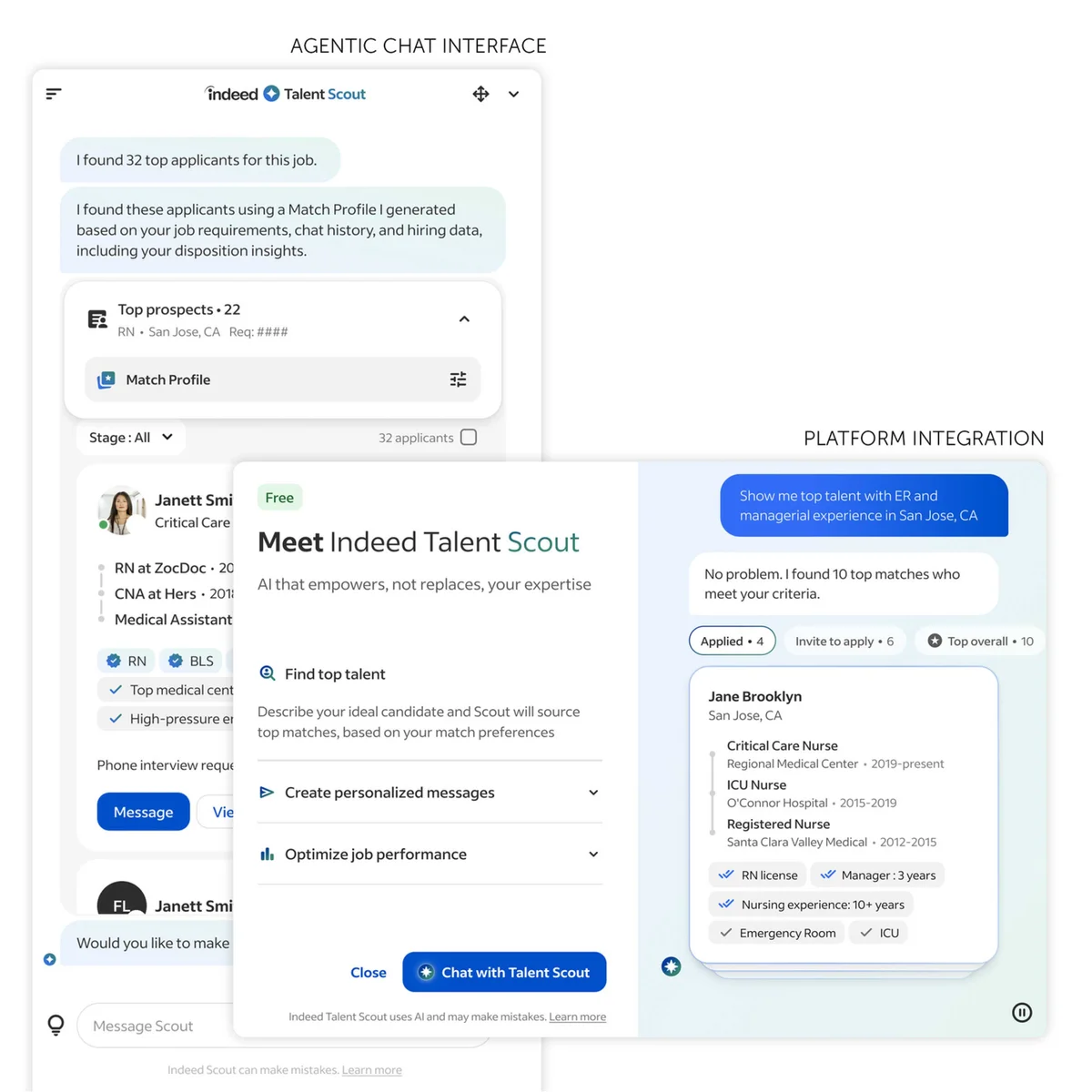
Large employers were not operating inside a single product. Hiring workflows lived across ATS platforms, internal tools, and Indeed surfaces, with sourcing, reviewing applicants, outreach, and coordination happening in separate systems. Instead of a unified workflow, employers were managing a fragmented process across multiple environments.
At the same time, most AI product strategies assumed employers would come into a new product experience. That was not realistic for this audience.
The opportunity was to bring AI into the environments employers already used, connecting data, workflows, and actions across systems. The risk was significant. If the system required behavior change or lived outside existing workflows, it would not be adopted.
Approach
Build, observe, adapt
Rather than defining the experience upfront, we focused on getting to a real product inside the environments employers already used.
Design and engineering worked together in code from the start, allowing the system to be tested across ATS integrations, browser extensions, and Indeed surfaces. Research ran alongside development, so decisions were shaped by real employer behavior in real workflows, not assumptions.
The goal was not to design a new destination. It was to understand how AI should operate within existing systems.
Defining the Integrated Hiring System
Early concepts were not just about interface, but about where and how the system should exist.
The core question was how AI could support hiring without requiring employers to change their tools or workflows. The system needed to operate across ATS platforms and Indeed surfaces, understand job, candidate, and performance context across systems, and surface relevant candidates and insights directly within existing workflows. It also needed to guide next actions without requiring navigation across tools, while maintaining continuity as employers moved between environments.
Rather than defining this in theory, it was brought into a real product early.
What this revealed was clear. Employers preferred working within their existing systems, and requiring navigation to a new product introduced friction. Value needed to be delivered within the flow of work, and systems that integrated into workflows proved more effective than standalone tools. These insights only emerged through real usage across environments.
Evolving from Product to System Layer
As the product matured, it became clear this was not a standalone product.
It evolved into a system that operated across multiple environments, connecting workflows that had previously been separate and interpreting context across systems. Instead of requiring users to switch tools, it guided actions directly within the environments where work was already happening.
This shifted the experience from new product adoption to AI embedded within existing workflows. The role of the interface evolved alongside it, delivering value without requiring users to initiate interaction, providing clear reasoning within the context of existing tools, and enabling action in place.
This was not about designing a new experience. It was about embedding intelligence into the existing one.
Designing for Cross-System Consistency
Talent Scout needed to function across multiple environments while maintaining a coherent experience. Hiring workflows spanned ATS platforms, Indeed product surfaces, and browser extensions, each with its own constraints and context.
To work effectively, the system needed to maintain consistent context across environments, connect data from multiple sources into a unified understanding, and enable actions without breaking the flow of work.
This was not a surface-level problem. It required system-level decisions to ensure the experience remained consistent regardless of where it was used. Working directly in code allowed these integrations and constraints to be tested early, before patterns were locked in.
Validating Through Real Environments
Validation was grounded in real employer workflows across actual systems. The goal was not to test ideal interactions, but to understand whether the system fit naturally into existing workflows, whether employers could take action without leaving their primary tools, and whether it reduced friction across environments.
It also meant understanding whether employers trusted the system and relied on it within their day-to-day work.
What emerged was consistent. Adoption depended on fitting into existing workflows, not replacing them. Context needed to persist across systems to be useful, and reducing navigation across tools had a meaningful impact on efficiency. Embedded systems consistently outperformed standalone experiences.
By validating in real environments, the product direction evolved based on how employers actually worked.
Impact
Talent Scout validated a new model for how AI can support hiring. It shifted AI from a standalone product to an embedded system across workflows, enabling hiring actions to happen within existing ATS and product environments.
It connected fragmented workflows into a more unified experience, established patterns for cross-system AI integration, and reduced friction by meeting employers where they already work.
Key Contributions that Shaped the Outcome
We defined an embedded AI model for hiring workflows, shaping how AI could integrate into existing systems instead of requiring new product adoption.
We validated product direction in real environments by testing across ATS platforms and live workflows, ensuring the system aligned with how employers actually operate.
We connected workflows across systems, enabling sourcing, evaluation, and action to function as a unified experience across tools.
We designed for system-level consistency, ensuring the experience remained coherent across ATS platforms, extensions, and embedded surfaces.
What We Delivered
We delivered early validation of an AI-driven hiring system within real employer environments, along with a real, testable product used to learn from employer behavior across systems.
The work established a shift from standalone tools to embedded AI across workflows, resulting in a system that connects candidates, insights, and actions across platforms.
It also created foundational patterns for cross-product and cross-system AI experiences.
Why Our Approach Matters
The success of this product depended on how well it fit into existing workflows. That could not be validated through static designs or isolated prototypes.
The system needed to be tested within real environments, across the tools employers already use, and alongside real hiring behavior.
Validation in real workflows made it possible to understand not just how the product looked, but whether it actually worked where hiring happens.
The experience evolved through real usage, ensuring it aligned with how employers actually hire.